|
|
| Line 25: |
Line 25: |
|
| |
|
| ==Development== | | ==Development== |
| After having designed the [[Aero Commander]] and [[Jet Commander]], [[Ted R. Smith]] founded the '''Ted Smith Aircraft Company''' in 1963 to build a new line of aircraft.<ref name=avconsumer/> The first Aerostar prototype, the Model 320, was built with two {{convert|160|hp|kW|abbr=on}} [[Lycoming IO-320]] engines and first flew in November 1966. The same aircraft was upgraded with a pair of {{convert|180|hp|kW|abbr=on}} [[Lycoming IO-360]] engines and a more streamlined vertical fin and renamed the Model 360; it was subsequently upgraded again with {{convert|200|hp|kW|abbr=on}} IO-360s and renamed again as the Model 400. The aircraft finally entered production as the Aerostar 600 with two {{convert|290|hp|kW|abbr=on}} [[Lycoming IO-540]]-K engines, first flown in December 1967. Also produced, and the base of most of the subsequent models, was a version with [[turbocharged]] engines, the Aerostar 601.{{sfn|Simpson|1991|pp=326–327}} | | After having designed the [[Aero Commander]] and [[Jet Commander]], [[Ted R. Smith]] founded the '''Ted Smith Aircraft Company''' in 1963 to build a new line of aircraft. The [[Bellanca Aircraft Company]] and [[Vought|Chance Vought]] also expressed interest in acquiring the design. In 1978, the Aerostar line was acquired by the [[Piper Aircraft Corporation]], which continued to build two variants, the 600A and 601B, and then re-introduced the 601P.{{sfn|Simpson|1991|p=326}}<!--Simpson does not state that Piper acquired the entire Ted R. Smith company.--> Piper continued using the basic Ted Smith model designation system but prefixed each model as the '''PA-60'''.{{sfn|Simpson|1991|pp=326–327}} |
| | |
| The aircraft were originally built at [[Van Nuys]], California, but in 1968 the company was bought by the [[American Cement Company]]. The acquisition was not a success, and in 1969 the company was sold again to Butler Aviation, a major [[fixed base operator]] and owner of [[Mooney Airplane Company]]. The new company was renamed Aerostar Aircraft Corporation, and plans were made to move production to the Mooney plant at [[Kerrville]], Texas, but Butler got into a dispute with American Cement over alleged corrosion problems with the airframe; the U.S. [[Federal Aviation Administration]] (FAA) investigated and found that no such problem existed, but the dispute resulted in a two-year production hiatus and cancellation of the plant relocation plan.<ref name=avconsumer/>{{sfn|Simpson|1991|p=326}} In 1971, Smith attempted to repurchase the rights and announced he would be building an all-new design that was better than the Aerostar, but negotiations broke down.<ref>{{cite journal|journal=Air Progress|page=16|date=December 1971}}</ref> The [[Bellanca Aircraft Company]] and [[Vought|Chance Vought]] also expressed interest in acquiring the design.<ref name=avconsumer/>
| |
| | |
| In 1972, Ted Smith successfully bought back all the rights to the aircraft and began manufacturing Aerostars under the '''Ted R. Smith and Associates''' banner in [[Santa Maria, California |Santa Maria]], California, introducing the [[Cabin pressurization|pressurized]] Aerostar 601P along with the Aerostar 700 '''Superstar'''. In 1976, the company name was changed to the '''Ted Smith Aerostar Corporation'''.{{sfn|Simpson|1991|p=326}} 1974 saw the introduction of the successful 601P, which introduced [[cabin pressurization]], allowing more convenient high-altitude operation; the designers were able to adapt the fuselage to pressurization without having to limit its [[service life]]. The 601P and the 601B, which was introduced in 1977, both feature improvements to the turbocharging system to increase engine reliability and ease engine operation; the improved turbo system and a {{convert|2.5|ft|adj=on}} greater wingspan improve climb performance.<ref name=TheAerostars/>
| |
| | |
| Smith died suddenly in 1976.<ref name=Dream>{{cite web |url=https://www.aopa.org/news-and-media/all-news/2014/february/pilot/aerostar |title=Ted Smith's Dream: Record-setting piston twin sprouts jet engines |website=aopa.org |last=Hirschman |first=Dave |publisher=[[Aircraft Owners and Pilots Association]] |date=February 5, 2014 |access-date=July 3, 2024}}</ref> In 1978, the Aerostar line was acquired by the [[Piper Aircraft Corporation]], which continued to build two variants, the 600A and 601B, and then re-introduced the 601P.{{sfn|Simpson|1991|p=326}}<!--Simpson does not state that Piper acquired the entire Ted R. Smith company.--> Piper continued using the basic Ted Smith model designation system but prefixed each model as the '''PA-60'''.{{sfn|Simpson|1991|pp=326–327}}<ref name=":0" /> Piper introduced the enhanced 602P, which was initially marketed as the '''Sequoya''',{{sfn|Simpson|1991|p=326}}{{efn|Simpson says the Sequoya is the 601P on page 326 but says it's the 602P on Page 327.{{sfn|Simpson|1991|pp=326–327}} 602P is more consistent with the previous model history.}} and also put the 700 Superstar into production as the 700P.<ref name=TheAerostars/> The 602P was the first model with a turbocharger system built and certified by the engine manufacturer, rather than a turbo system designed and installed by Ted Smith or Piper.<ref name=avconsumer/> After discontinuing production of the non-pressurized models, Piper moved production to [[Vero Beach]], Florida, building the last Aerostar there in 1984.{{sfn|Simpson|1991|p=326}}<ref name=Dream/>
| |
| | |
| Smith conducted engineering studies for a [[jet engine|jet]]-powered Aerostar, and also envisioned [[turboprop]] power and a single-engine [[trainer aircraft]] using the same basic airframe, but these plans never came to fruition during the aircraft's production run.<ref name=Dream/><ref name=avconsumer>{{cite web |url=https://www.aviationconsumer.com/aircraftreviews/aerostar-600-700-series/ |title=Aerostar 600, 700 series |author=<!--Not stated--> |date=October 29, 2019 |website=aviationconsumer.com |publisher=The Aviation Consumer |access-date=July 5, 2024}}</ref>
| |
|
| |
|
| ==Design== | | ==Design== |
| The Aerostar emerged as a [[mid-wing]] cantilever [[monoplane]] powered by two wing-mounted [[piston engines]], with [[retractable landing gear]] in a [[tricycle landing gear|tricycle]] configuration. It is designed to seat six, and is distinguished from light twins of similar size and weight by its high [[wing loading]], careful attention to fine aerodynamic details, a [[mid wing]], and in early models, the absence of [[cowl flaps]]; Smith was adamant that they were not needed because of the refined cooling system design. Despite this, the later 700P used cowl flaps because engine cooling of earlier models proved marginal if the system is not maintained rigorously.<ref name=TheAerostars>{{cite web |url=https://www.aopa.org/news-and-media/all-news/1998/august/pilot/the-aerostars |title=The Aerostars |website=aopa.org |last=Cook |first=Mark |publisher=[[Aircraft Owners and Pilots Association]] |date=August 5, 1998 |access-date=July 3, 2024}}</ref> | | The Aerostar emerged as a [[mid-wing]] cantilever [[monoplane]] powered by two wing-mounted [[piston engines]], with [[retractable landing gear]] in a [[tricycle landing gear|tricycle]] configuration. It is designed to seat six, and is distinguished from light twins of similar size and weight by its high [[wing loading]], careful attention to fine aerodynamic details, a [[mid wing]], and in early models, the absence of [[cowl flaps]]; Smith was adamant that they were not needed because of the refined cooling system design. Despite this, the later 700P used cowl flaps because engine cooling of earlier models proved marginal if the system is not maintained rigorously. |
| | |
| The engines of early 601s are turbonormalized—they retain the higher [[compression ratio]] typical of a non-turbocharged engine, and the turbo system is designed to primarily to compensate for increasing altitude by providing more boost pressure as the outside air pressure declines. Later models featured a redesigned turbo system intended to increase reliability and be more forgiving of improper operation by the pilot.<ref name=TheAerostars/> Unusual Aerostar design features include electrically operated remote fuel valves, which avert the need to run fuel lines into the cockpit; electro-hydraulic nosewheel steering; a [[flight control]] system that relies on push-pull rods and torque tubes rather than cables; and unusually thick and stiff wing skins, which—together with the high wing loading—give the Aerostar an unusually smooth ride in [[turbulence]].<ref name=avconsumer/><ref name=TheAerostars/>
| |
| | |
| Some disadvantages of the aircraft compared to its competitors are the absence of a nose baggage locker, and a cabin that can only be accessed through a single clamshell door next to the pilot's seat; aircraft occupants other than the [[pilot in command]] must climb over the folded pilot's seat to access their seats.<ref name=TheAerostars/>
| |
| | |
| Aerostar model numbers nominally refer to the total installed engine horsepower, but some model numbers vary from the precise total, particularly the later models.{{sfn|Simpson|1991|p=326}}
| |
| | |
| ==Operational history==
| |
| During the time of production, the Aerostar held the speed record for fastest twin piston [[general aviation]] aircraft,<ref>[http://www.pilotfriend.com/aircraft%20performance/aerostar/aerostar.htm "Certified Aircraft Database: Aerostar"]. ''Pilotfriend.com''. Retrieved 24 February 2019.</ref> capable of cruise speeds from {{convert|220|kn}} for the earliest 600 models to {{convert|261|kn}} for the later 700 models. Light construction, low drag, and powerful engines contribute to fast climb rates, while allowing high operating altitudes and class-leading fuel efficiency.<ref name=TheAerostars/>
| |
| | |
| A study of Aerostar accidents by ''The Aviation Consumer'' from 1978 to 1982 showed that the Aerostar had an accident rate of 12.9 per 100,000 flight hours, substantially more than the rate of the comparable [[Beechcraft Baron 58]] at 4.9 per 100,000 hours. A similar study conducted by ''Aviation Safety'' compared the safety records of eight similar models of twin-piston-engine aircraft and found that the Aerostar had the highest accident and fatal accident rate. According to the studies, the leading cause of Aerostar accidents was engine failures on takeoff. ''The Aviation Consumer'' notes that the Aerostar's high wing loading, which contributes to its high cruise speed, also gives it relatively unforgiving flying qualities on takeoff and landing; the aircraft requires relatively long runways, and pilots must keep the airspeed high during approach to avoid falling [[Drag_curve#Power_required_curves|behind the power curve]], which can cause an excessive sink rate. The [[Flap (aeronautics)|wing flaps]] of the Aerostar slow the aircraft relatively quickly, which may induce this problem, so pilots typically do not use the full 20-degree flap setting until the aircraft is close enough to the runway to ensure a safe landing.<ref name=avconsumer/>
| |
| | |
| The Aerostar has a history of accidents stemming from fuel mismanagement by the pilot.<ref name=avconsumer/> Most later Aerostars have a {{convert|41.5|gal|adj=on}} fuselage fuel tank and individual {{convert|62|gal|adj=on}} fuel tanks in each wing, which all feed into a common chamber near the fuselage tank; the common chamber in turn normally feeds the engines. However, the relative lack of wing [[Dihedral (aeronautics)|dihedral]] may cause the wing tanks to feed unevenly when used in this manner, causing a fuel imbalance as flight progresses. This problem can be mitigated by using the fuel valves to crossfeed fuel from one wing tank to the opposite engine, bypassing the common chamber; however, the wing tanks are prone to [[unporting]] when they are mostly empty, causing engines to lose power or stop running. This hazard can be exacerbated if electrical power is lost, as the electrically operated fuel valves will become inoperable, preventing the pilot from switching back to the fuselage tank. To mitigate these problems, a 1984 [[airworthiness directive]] (AD) required owners to install individual, more accurate fuel gauges for each wing tank, a dedicated low-fuel warning light, and placards explaining correct crossfeed procedures.<ref name=avconsumer/><ref name=TheAerostars/>
| |
| | |
| The Aerostar has a history of problems with the clamshell-style entry door, which is located directly in front of the left-hand propeller, making it critical for the door to be secured before takeoff. A number of accidents have resulted from the upper half of the door coming open in flight and in some cases separating from the aircraft. Although it was not conclusively listed as causal, an unsecured upper door is widely thought to have contributed to a 1988 crash that killed pilot and auto racing driver [[Al Holbert]].<ref name=avconsumer/> That year, the FAA issued an AD requiring inspection of the door rigging, a placard explaining proper door operation, and a dedicated door-ajar warning light. In addition, the FAA has issued warnings regarding an aftermarket door strut which required an installation procedure that may damage a door gusset; the gusset may break in flight and cause the door seal to fail, potentially causing [[uncontrolled decompression]] in pressurized versions of the Aerostar.<ref name=avconsumer/>
| |
| | |
| Although nominally a six-seat aircraft, owners often remove center-row seats because most Aerostars have inadequate payload to simultaneously carry six people, their baggage, and a large fuel load, and removing the seats improves access and legroom in the third-row seats, which are quieter than the other seating positions and are therefore preferred by many passengers.<ref name=avconsumer/><ref name=TheAerostars/>
| |
| | |
| The Aerostar has a reputation for high maintenance requirements and servicing costs due to a cooling system design that is intolerant of poor maintenance, a lack of working space around various aircraft systems, and a turbo system that is sensitive to exhaust system problems.<ref name=avconsumer/><ref name=TheAerostars/>
| |
| | |
| The Aerostar [[type certificate]] and manufacturing documentation were sold in 1991 to former Ted Smith Aerostar employees Jim Christy and Steve Speer, who operate '''Aerostar Aircraft Corporation''' (originally Machen Incorporated<ref name=avconsumer/>), providing maintenance and support for the aircraft and continued [[research and development]].<ref name=TheAerostars/><ref name=Dream/><ref>{{cite web |url=https://aerostaraircraft.com/about/ |title=ABOUT - Aerostar Aircraft |date=2018 |website=aerostaraircraft.com |access-date=July 3, 2024}}</ref> In 2006, Speer restarted design studies for a jet-powered Aerostar, and in 2010, Aerostar Aircraft first flew the '''Aerostar Jet''', a 601P refitted with a pair of wing-mounted {{cvt|1,460|lbf|kN}} [[Pratt & Whitney Canada PW600|Pratt & Whitney CW615F]] engines, providing an estimated maximum cruise speed of {{convert|355|kn}}. In 2014, Aerostar Aircraft said it was investigating production of the aircraft.<ref name=Dream/>
| |
|
| |
|
| ==Variants==
| | The engines of early 601s are turbonormalized—they retain the higher [[compression ratio]] typical of a non-turbocharged engine, and the turbo system is designed to primarily to compensate for increasing altitude by providing more boost pressure as the outside air pressure declines. Later models featured a redesigned turbo system intended to increase reliability and be more forgiving of improper operation by the pilot. capable of cruise speeds from {{convert|220|kn}} for the earliest 600 models to {{convert|261|kn}} for the later 700 models. Light construction, low drag, and powerful engines contribute to fast climb rates, while allowing high operating altitudes and class-leading fuel efficiency. In 2006, Speer restarted design studies for a jet-powered Aerostar, and in 2010, Aerostar Aircraft first flew the '''Aerostar Jet''', a 601P refitted with a pair of wing-mounted {{cvt|1,460|lbf|kN}} [[Pratt & Whitney Canada PW600|Pratt & Whitney CW615F]] engines, providing an estimated maximum cruise speed of {{convert|355|kn}}. In 2014, Aerostar Aircraft said it was investigating production of the aircraft. |
| ;Model 320
| |
| :First prototype, powered by two {{convert|160|hp|kW|abbr=on}} [[Lycoming IO-320]] engines{{sfn|Simpson|1991|p=327}}
| |
| ;Model 360
| |
| :Modification of first prototype with two {{convert|180|hp|kW|abbr=on}} [[Lycoming IO-360]] engines and a redesigned [[empennage]]{{sfn|Simpson|1991|pp=326–327}}<ref name="jawa67p360">Taylor 1967, p. 360.</ref>
| |
| ;Model 400 | | ;Model 400 |
| :Modification of first prototype with two {{convert|200|hp|kW|abbr=on}} IO-360 engines; type certified, but did not enter production{{sfn|Simpson|1991|p=327}}<ref name="jawa67p360"/> | | :Modification of first prototype with two {{convert|200|hp|kW|abbr=on}} IO-360 engines; type certified, but did not enter production{{sfn|Simpson|1991|p=327}} 282 produced under four different company names{{sfn|Simpson|1991|p=327}} |
| ;Model 500/500P
| |
| :Projected versions with {{convert|250|hp|kW|abbr=on}} [[fuel injected]] engines, to be non-pressurized and pressurized respectively; none built{{sfn|Simpson|1991|p=327}}
| |
| ;{{visible anchor|600 (later PA-60-600)}}
| |
| :Initial production model with two {{convert|290|hp|kW|abbr=on}} [[Lycoming IO-540]]-K engines,<ref name=":0">{{Cite web |title=Type Certificate Data Sheet No. A17WE |url=https://drs.faa.gov/browse/excelExternalWindow/ABBBB99FF89DC2ED86257A8B006EE54B.0001 |access-date=June 12, 2024 |website=[[Federal Aviation Administration]]}}</ref> 282 produced under four different company names{{sfn|Simpson|1991|p=327}}
| |
| ;600A | | ;600A |
| :Model 600 with some minor detail changes and improved engines,<ref name=avconsumer/>{{sfn|Simpson|1991|p=327}} 206 built<ref name=avconsumer/> | | :Model 600 with some minor detail changes and improved engines, |
| ;600E
| |
| :Designation used for aircraft sold in Europe{{sfn|Simpson|1991|p=327}}
| |
| ;601 (later PA-60-601):This aircraft still holds the land closed speed record for a production piston twin{{Citation needed|date=June 2024}}
| |
| :Model 600 with 290 hp turbocharged Lycoming [[Lycoming IO-540|TIO-540]] engines,<ref name=":0" /> 117 built{{sfn|Simpson|1991|p=327}}
| |
| ;601B
| |
| :Model 601 with increased wingspan and improved turbo system,<ref name=avconsumer/><ref name=TheAerostars/> 44 built{{sfn|Simpson|1991|p=327}}
| |
| ;601P (later PA-60-601P)
| |
| :Pressurized version of 601 with increased gross weight,<ref name=avconsumer/><ref name=":0" /> increased wingspan and improved turbo system from 601B,<ref name=TheAerostars/><ref name=avconsumer/> 492 built{{sfn|Simpson|1991|p=327}}
| |
| ;602P Sequoya (later PA-60-602P)
| |
| :Piper-developed version of 601P with 290 hp Lycoming TIO-540-AA1A5 engines, 124 built<ref name=":0" />{{sfn|Simpson|1991|p=327}}
| |
| ;620
| |
| :The prototype pressurized Aerostar with {{convert|310|hp|kW|abbr=on}} TIO-540 engines, one built{{sfn|Simpson|1991|p=327}} (at Van Nuys in mid-1969){{Citation needed|date=June 2024}}
| |
| ;700 Superstar
| |
| :Prototype of stretched fuselage variant with two IO-540M engines, one built{{sfn|Simpson|1991|p=327}}
| |
| ;700P (later PA-60-700P)
| |
| :602P with counter-rotating {{convert|350|hp|kW|abbr=on}} Lycoming TIO-540-U2A engines,<ref name=":0" /> 26 built{{sfn|Simpson|1991|p=327}}
| |
| ;702P
| |
| :New modification of 700P with a reinforced nose gear allowing for higher takeoff weight{{Citation needed|date=June 2024|reason=This model not addressed in TCDS or Simpson book; is it an aftermarket STC modification?}}
| |
| ;800
| |
| :601P with stretched fuselage, enlarged tail and two {{convert|400|hp|kW|abbr=on}} Lycoming engines, one built{{sfn|Simpson|1991|p=327}}
| |
| ;Super 700
| |
| :Machen/Aerostar Aircraft conversion of 601P or 602P with three-bladed [[Hartzell]] propellers, {{convert|350|hp|kW|abbr=on}} Lycoming TIO-540-U2A engines, and increased gross weight<ref name=avconsumer/>
| |
| ;Speedstar 850
| |
| :A modification to replace the twin piston engines with a single nose mounted turboprop<ref>{{cite journal|journal=Twin and Turbine Magazine|date=September 2010}}</ref>
| |
| ;Aerostar Jet | | ;Aerostar Jet |
| :601P with two {{cvt|1,460|lbf|kN}} [[Pratt & Whitney Canada PW600|Pratt & Whitney CW615F]] engines; one converted<ref name=Dream/> | | :601P with two {{cvt|1,460|lbf|kN}} [[Pratt & Whitney Canada PW600|Pratt & Whitney CW615F]] engines; one converted The [[National Transportation Safety Board]] (NTSB) attributed the crash to a pilot-induced [[Stall (fluid dynamics)|stall]]. The accident report noted that the upper half of the cabin door was found open; it is speculated that the door opened on takeoff and Holbert was trying to close it when he lost control of the aircraft. |
| | | * On January 4, 1995, Piper PA-60-601P ''N720EM'', piloted by [[Eduardo Mata]], former [[Conducting|conductor]] of the [[Dallas Symphony Orchestra]], crashed into a ravine and exploded after an engine failure during climbout from [[Cuernavaca Airport]], killing Mata and his single passenger. Investigators were unable to determine the cause of the engine failure. |
| <gallery widths="200px" heights="155px">
| |
| File:Smith Aerostar 601 CF-BBA ABIN 01.07.71 edited-3.jpg|Ted Smith-built Aerostar 601 in 1971
| |
| File:piper pa-60-600 aerostar n70vb arp.jpg|Piper PA-60-600 Aerostar, built in 1977
| |
| File:N6081p.jpg|A Piper Sequoia 602P at Paris Air Show Le Bourget in 1981
| |
| File:Aerostar Turbine.jpg|An experimental turbine powered Aerostar FJ-80 in 2011
| |
| File:1980Aerostar601p.jpg|1980 Aerostar 601P
| |
| File:SPEEDSTAR850.jpg|Speedstar 850
| |
| File:Aerostar 600 KLVK.jpg|Aerostar 600
| |
| </gallery>
| |
| <!--
| |
| ==Operators== -->
| |
| | |
| ==Accidents and incidents==
| |
| * On September 30, 1988, [[Al Holbert]], auto racing driver and winner of the informal [[Triple Crown of endurance racing]], was killed when the Piper PA-60-601P he was piloting, [[aircraft registration]] ''N14HR'', crashed after takeoff from [[Ohio State University Airport]]. Eyewitnesses said the aircraft seemed to struggle to gain altitude, and then crashed during an apparent turn back to the airport, catching fire on impact.<ref>{{cite news |author=<!--not stated--> |date=October 2, 1988 |title=Race Driver Holbert Dies in Plane Crash |url=https://www.latimes.com/archives/la-xpm-1988-10-02-sp-5041-story.html |work=[[Los Angeles Times]] |location=Los Angeles |access-date=July 4, 2024}}</ref> The [[National Transportation Safety Board]] (NTSB) attributed the crash to a pilot-induced [[Stall (fluid dynamics)|stall]].<ref>{{cite report |publisher=[[National Transportation Safety Board]] |date=June 25, 1990 |title=Aviation Investigation Final Report |url=https://data.ntsb.gov/carol-repgen/api/Aviation/ReportMain/GenerateNewestReport/13976/pdf |docket=CHI88FA249 |access-date=July 4, 2024}}</ref> The accident report noted that the upper half of the cabin door was found open; it is speculated that the door opened on takeoff and Holbert was trying to close it when he lost control of the aircraft.<ref name=avconsumer/>
| |
| * On April 4, 1991, in the [[1991 Merion mid-air collision|Merion mid-air collision]], Piper PA-60-601 ''N3645D'' collided with a [[Bell 412SP]] helicopter, ''N78S'', over [[Lower Merion Township]], Pennsylvania, during a visual inspection of the Piper's nose landing gear. The collision killed all four pilots in both aircraft along with [[John Heinz]], [[United States Senator]] for Pennsylvania, who was the sole passenger in the Piper. Wreckage fell on an elementary school and nearby houses, killing two schoolchildren, severely burning a third, and causing minor injuries to four other bystanders. The NTSB attributed the accident to poor judgment and decision-making by the pilots of both aircraft. A contributing factor was a lack of direction in the PA-60 flight manual regarding procedures if the cockpit indicator light did not show that the nosegear was down and locked; landing with improperly deployed gear would have been safer than the improvised aerial inspection, the NTSB said.<ref>{{cite web | url = http://articles.baltimoresun.com/1991-04-05/news/1991095117_1_heinz-plane-elementary-school | archive-url= https://web.archive.org/web/20120913071658/http://articles.baltimoresun.com/1991-04-05/news/1991095117_1_heinz-plane-elementary-school | title = Sen. John Heinz killed in plane crash in Philadelphia | newspaper = [[The Baltimore Sun]] |first=Larry |last=King |date=April 5, 1991 |url-access=limited | archive-date=2012-09-13}}</ref><ref>{{cite report |url=https://www.ntsb.gov/investigations/AccidentReports/Reports/AAR9101S.pdf |title=Aircraft Accident/Incident Summary Report |docket=AAR9101S |publisher=[[National Transportation Safety Board]] |date=September 17, 1991 |via=NTSB.gov}}</ref>
| |
| * On January 4, 1995, Piper PA-60-601P ''N720EM'', piloted by [[Eduardo Mata]], former [[Conducting|conductor]] of the [[Dallas Symphony Orchestra]], crashed into a ravine and exploded after an engine failure during climbout from [[Cuernavaca Airport]], killing Mata and his single passenger. Investigators were unable to determine the cause of the engine failure.<ref>{{cite news |author=<!--not stated--> |title=MEXICO PLANE CRASH KILLS MAESTRO EDUARDO MATA |url=https://www.deseret.com/1995/1/5/19151618/mexico-plane-crash-kills-maestro-eduardo-mata/ |work=[[The Deseret News]] |agency=[[Associated Press]] |date=January 5, 1995 |access-date=July 3, 2024|ref=none}}</ref><ref>{{cite web |url=https://www.baaa-acro.com/phasetype/takeoff-climb?page%5Cu003d6=&page=134 |title=Takeoff (climb) Bureau of Aircraft Accidents Archive |website=baaa-acro.com |access-date=July 3, 2024}}</ref> | |
|
| |
|
| ==Specifications (700P)== | | ==Specifications (700P)== |
| {{Aircraft specs | | {{Aircraft specs |
| |ref=Jane's Civil and Military Aircraft Upgrades 1994–95<ref name="Janes Up94 p385-6">Michell 1994, pp. 385–386.</ref> | | |ref=Jane's Civil and Military Aircraft Upgrades 1994–95 |
| |prime units? = imp | | |prime units? = imp |
| |crew=1 | | |crew=1 |
| Line 144: |
Line 67: |
| |max speed mph=306 | | |max speed mph=306 |
| |cruise speed kmh=390 | | |cruise speed kmh=390 |
| |cruise speed note=<ref>55% power</ref><!-- if max speed unknown --> | | |cruise speed note=<!-- if max speed unknown --> |
| |cruise speed mph=242<!-- if max speed unknown --> | | |cruise speed mph=242<!-- if max speed unknown --> |
| |range km=1,648 | | |range km=1,648 |
| Aerostar / Superstar / Sequoya
|
|
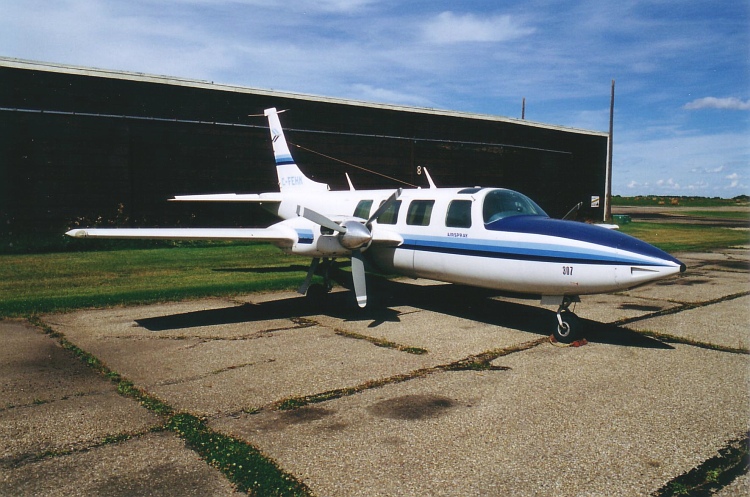
| An Aerostar 600 in Red Deer, Alberta in 2000
|
| Role
|
Light transport aircraft
|
| National origin
|
United States
|
| Manufacturer
|
Ted Smith Aircraft Company
Piper Aircraft Corporation
|
| Designer
|
Ted R. Smith
|
| First flight
|
1967
|
| Status
|
Active service
|
| Produced
|
1967–1984
|
| Number built
|
1,010
|
The Piper Aerostar (formerly the Ted Smith Aerostar) is an American twin-engined propeller-driven executive or light transport aircraft, designed by Ted R. Smith. It was originally built by Ted Smith Aircraft Company, but the design was acquired in 1978 by the Piper Aircraft Corporation, which continued production of the aircraft as the PA-60.
Development
After having designed the Aero Commander and Jet Commander, Ted R. Smith founded the Ted Smith Aircraft Company in 1963 to build a new line of aircraft. The Bellanca Aircraft Company and Chance Vought also expressed interest in acquiring the design. In 1978, the Aerostar line was acquired by the Piper Aircraft Corporation, which continued to build two variants, the 600A and 601B, and then re-introduced the 601P. Piper continued using the basic Ted Smith model designation system but prefixed each model as the PA-60.
Design
The Aerostar emerged as a mid-wing cantilever monoplane powered by two wing-mounted piston engines, with retractable landing gear in a tricycle configuration. It is designed to seat six, and is distinguished from light twins of similar size and weight by its high wing loading, careful attention to fine aerodynamic details, a mid wing, and in early models, the absence of cowl flaps; Smith was adamant that they were not needed because of the refined cooling system design. Despite this, the later 700P used cowl flaps because engine cooling of earlier models proved marginal if the system is not maintained rigorously.
The engines of early 601s are turbonormalized—they retain the higher compression ratio typical of a non-turbocharged engine, and the turbo system is designed to primarily to compensate for increasing altitude by providing more boost pressure as the outside air pressure declines. Later models featured a redesigned turbo system intended to increase reliability and be more forgiving of improper operation by the pilot. capable of cruise speeds from 220 knots (410 km/h; 250 mph) for the earliest 600 models to 261 knots (483 km/h; 300 mph) for the later 700 models. Light construction, low drag, and powerful engines contribute to fast climb rates, while allowing high operating altitudes and class-leading fuel efficiency. In 2006, Speer restarted design studies for a jet-powered Aerostar, and in 2010, Aerostar Aircraft first flew the Aerostar Jet, a 601P refitted with a pair of wing-mounted 1,460 lbf (6.5 kN) Pratt & Whitney CW615F engines, providing an estimated maximum cruise speed of 355 knots (657 km/h; 409 mph). In 2014, Aerostar Aircraft said it was investigating production of the aircraft.
- Model 400
- Modification of first prototype with two 200 hp (150 kW) IO-360 engines; type certified, but did not enter production 282 produced under four different company names
- 600A
- Model 600 with some minor detail changes and improved engines,
- Aerostar Jet
- 601P with two 1,460 lbf (6.5 kN) Pratt & Whitney CW615F engines; one converted The National Transportation Safety Board (NTSB) attributed the crash to a pilot-induced stall. The accident report noted that the upper half of the cabin door was found open; it is speculated that the door opened on takeoff and Holbert was trying to close it when he lost control of the aircraft.
- On January 4, 1995, Piper PA-60-601P N720EM, piloted by Eduardo Mata, former conductor of the Dallas Symphony Orchestra, crashed into a ravine and exploded after an engine failure during climbout from Cuernavaca Airport, killing Mata and his single passenger. Investigators were unable to determine the cause of the engine failure.
Specifications (700P)
Data from Jane's Civil and Military Aircraft Upgrades 1994–95
General characteristics
- Crew: 1
- Capacity: 5 passengers
- Length: 34 ft 9.75 in (10.61 m)
- Wingspan: 36 ft 8 in (11.18 m)
- Height: 12 ft 1 in (3.68 m)
- Wing area: 178.2 sq ft (16.56 m2)
- Empty weight: 4,275 lb (1,939 kg)
- Gross weight: 6,315 lb (2,864 kg)
- Powerplant: 2 × Avco Lycoming TIO-540-U2A flat six counter-rotating piston , 350 hp (261 kW) each
Performance
- Maximum speed: 306 mph (492 km/h, 266 kn)
- Cruise speed: 242 mph (390 km/h, 210 kn)
- Range: 1,024 mi (1,648 km, 890 nmi)
- Service ceiling: 25,000 ft (7,620 m)
- Rate of climb: 1,840 ft/min (9.4 m/s)
See also
Aircraft of comparable role, configuration, and era
References
Notes
Citations
Bibliography
- The Illustrated Encyclopedia of Aircraft (Part Work 1982–1985), 1985, Orbis Publishing
- Michell, Simon. Jane's Civil and Military Aircraft Upgrades 1994–95. Coulsdon, UK: Jane's Information Group, 1994. <templatestyles src="Module:Citation/CS1/styles.css"></templatestyles>ISBN 0-7106-1208-7.
- Simpson, R.W. Airlife's General Aviation, 1991, Airlife Publishing, <templatestyles src="Module:Citation/CS1/styles.css"></templatestyles>ISBN 1-85310-194-X
- Taylor, John W. R. Jane's All The World's Aircraft 1967–68. London: Sampson Low, Marston & Company, 1967.
External links
<templatestyles src="Hlist/styles.css"></templatestyles><templatestyles src="Module:Navbox/styles.css"></templatestyles>
| <templatestyles src="Hlist/styles.css"></templatestyles><templatestyles src="Module:Navbar/styles.css"></templatestyles> |
|---|
Company
Numerical
designations | | Single-engine prop aircraft | | High wing | |
|---|
| Low wing | |
|---|
| Mid wing | |
|---|
|
|---|
| Multi-engine aircraft | |
|---|
| Jets | |
|---|
|
|---|
| Names | |
|---|
Military
designations | |
|---|

 Media related to Piper Aerostar at Wikimedia Commons
